Welcome to the Weekly Weather Update – your guide to the world’s oceans and seas. Each week, we highlight key marine weather patterns and analyse unusual or significant weather events. From calm spells under high pressure to tropical cyclones forming in equatorial waters, and from jet streams steering oceanic storms to anomalies in sea-surface temperature that shape global climate patterns. Here’s what this week’s weather has in store.
The North Sea
Low pressure will continue to dominate the northern Atlantic, with several low-pressure systems passing north of the United Kingdom. As a result, weather conditions over the North Sea will remain unsettled at times during the coming week.
Occasionally, ridges of high pressure will move across the area, bringing brief periods of more stable conditions. However, overall the weather pattern remains changeable and generally unstable.
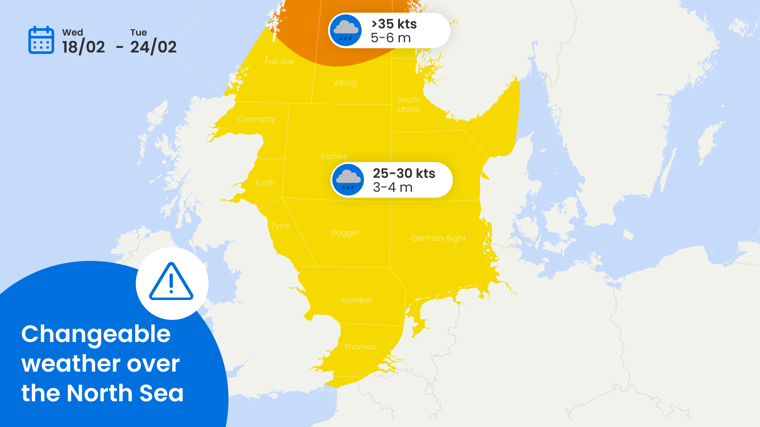
Winds across most of the North Sea may increase to 25–30 knots at times, with gusts reaching 35–40 knots and locally slightly higher values possible. Significant wave heights are generally expected to build to 3–4 meters.
The northernmost parts of the North Sea are expected to see the most unsettled weather, particularly on Friday, when winds could exceed 35 knots. Waves of 5–6 meters may also occur in this area (see Figure 1).
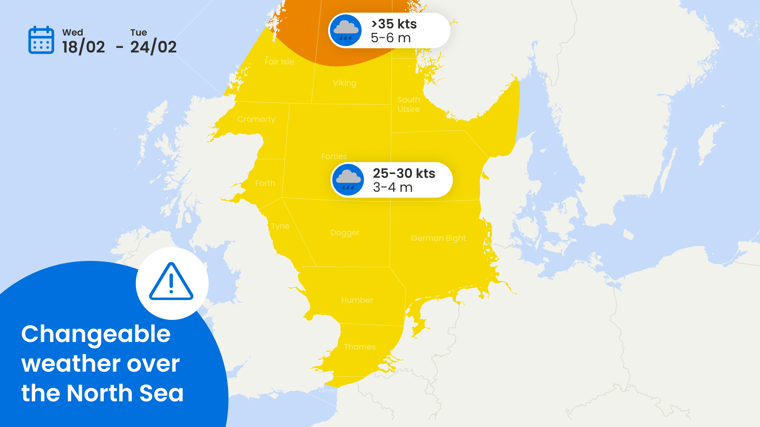 Figure 1: Changeable weather over the North Sea in the coming week.
The northern Atlantic
The weather over the northern Atlantic is particularly active at this time of year, posing potential hazards to many coastal areas. The western coast of Ireland frequently experiences strong winds of 30–35 knots and high waves reaching 5–7 meters offshore.
Stormy conditions are also common in the Bay of Biscay. On Wednesday and Thursday, the region is expected to experience severe weather, with winds generally above 30 knots and exceeding 40 knots in some areas. Offshore waves may reach extreme heights of 8–9 meters. From Friday onward, conditions improve slightly but remain potentially dangerous.
The east coast of the United States and southeastern Canada will also be affected by successive low-pressure systems during the coming week. While nearshore areas are unlikely to see particularly dangerous conditions, offshore regions are expected to experience severe weather. Winds may reach 45–50 knots at times, with waves exceeding 3 meters nearshore and increasing further offshore. In some distant offshore areas, waves could even surpass 11 meters.
Conclusion
Low pressure dominates the northern Atlantic, bringing unsettled and potentially hazardous weather to many coastal regions. The North Sea is also affected, with occasional high-pressure ridges providing brief respite, resulting in generally changeable conditions throughout the week.
Stay updated on LinkedIn
We plan to post this Weekly Weather Update on our Infoplaza for Marine Weather Operations LinkedIn page as well. This is also the place where we will share other insightful marine weather articles, so be sure to follow us to never miss an update.