Welcome to the Weekly Weather Update – your guide to the world’s oceans and seas. Each week, we highlight key marine weather patterns and analyse unusual or significant weather events. From calm spells under high pressure to tropical cyclones forming in equatorial waters, and from jet streams steering oceanic storms to anomalies in sea-surface temperature that shape global climate patterns. Here’s what this week’s weather has in store.
Eastern North Atlantic
Low pressure will continue to dominate the North Atlantic in the coming week. On Wednesday, a deep low pressure system located well southwest of Ireland will slowly move eastward. By Friday, the low is expected to be near Ireland, where it will weaken and dissipate over the weekend.
This system will bring stormy conditions to Ireland on Wednesday and Thursday. Winds to the west and south of the island are expected to increase to 25–35 knots, with possible gusts reaching 40–50 knots. Significant wave heights are forecast to rise to 3–5.5 meters.
Early on Friday, as the low approaches the island, average winds southwest of Ireland the winds and waves persist to be as strong. As the low weakens, moves eastward, and eventually dissipates, weather conditions around Ireland are expected to gradually improve.
At the same time, this low will also influence weather conditions over the Bay of Biscay. On Wednesday, general winds up to 20-35 knots are expected. Wave heights will generally be above 2 meters, increasing further offshore, with localized peaks reaching 4–5.5 meters.
Early on Thursday, conditions are expected to improve briefly. However, later in the day, winds of 25–35 knots are likely at times across much of the Bay again, with slightly lower wind speeds closer to the coast.
The weather over the Bay is expected to be calmer during the weekend. However, a new low pressure system is expected to pass over the Bay of Biscay early next week, bringing unsettled weather to the region once again. As this event is still some time away, we strongly advise monitoring updated weather forecasts for the latest information.
Western North Atlantic
While these developments unfold over the eastern North Atlantic, another notable system is expected to form east of the United States. A low pressure system is forecast to develop well east of New York late on Saturday and then move northeast while rapidly intensifying. The system is expected to move NE across the Atlantic.
At this time, the low is expected to bring severe weather to the northeastern coast of the United States and southeastern Canada late Saturday into early Sunday. Offshore winds may increase to 40–45 knots, with slightly lower speeds closer to the coast. Wave heights are also expected to increase significantly, reaching 9.5–10 meters far offshore and 3–3.5 meters near land.
As the low continues to move northeastward, the weather gradually improves. Keep a close eye on weather forecasts toward the end of this week and into next week for the latest updates.
The North Sea
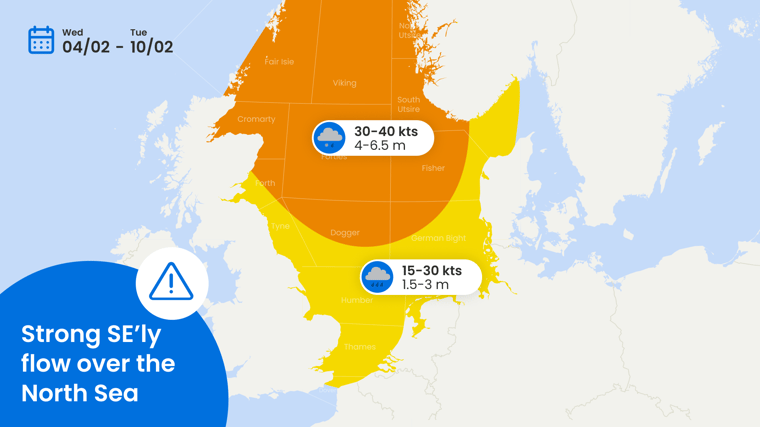
The synoptic situation over the North Sea is expected to remain fairly static in the coming week. While low pressure continues to dominate the Atlantic, high pressure persists over Scandinavia. Together, these systems create tightly packed isobars across much of the North Sea for nearly the entire forecast period.
Strong southeasterly flow is expected to persist across the entire North Sea throughout the week. Only the southern parts of the region may experience brief periods of slight improvement.
In general, winds over the central and northern parts of the North Sea are expected to range between 30–40 knots, with significant wave heights increasing to around 4 meters and occasionally up to 6.5 meters. Conditions are expected to be calmer in the southern areas, where winds will generally range from 15–30 knots and wave heights are not expected to exceed 1.5–3 meters (see Figure 1).
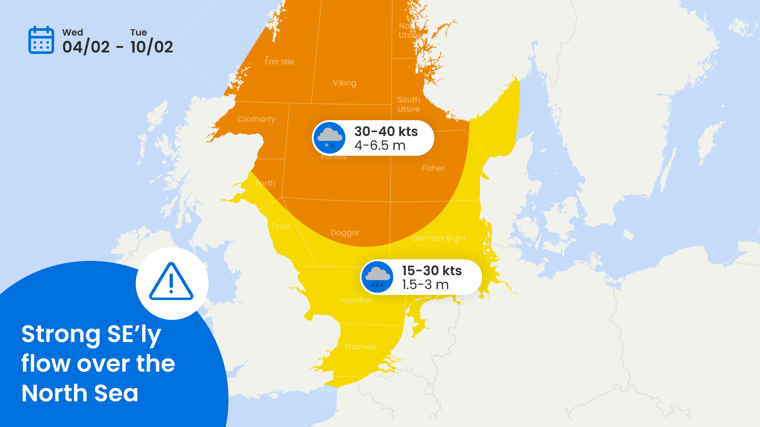 Figure 1: Strong southeasterly flow over the North Sea from 4–10 February.
Conclusion
Low pressure persists over the North Atlantic, bringing stormy and locally severe weather to some regions of the ocean. In combination with high pressure over Scandinavia, this system also influences the North Sea, maintaining a strong and fairly steady southeasterly flow across the region. Keep an eye on weather forecasts and stay safe!
Stay updated on LinkedIn
We plan to post this Weekly Weather Update on our Infoplaza for Marine Weather Operations LinkedIn page as well. This is also the place where we will share other insightful marine weather articles, so be sure to follow us to never miss an update.