
Welcome to the Weekly Weather Update – your guide to the world’s oceans and seas. Each week, we highlight key marine weather patterns and analyse unusual or significant weather events. From calm spells under high pressure to tropical cyclones forming in equatorial waters, and from jet streams steering oceanic storms to anomalies in sea-surface temperature that shape global climate patterns. Here’s what this week’s weather has in store.
Autumn weather over the North Sea
A large and complex low-pressure system is currently located just northwest of Ireland and will move into the UK over the coming days. There, the low will continue to swirl around throughout the next week. This is because a strong high-pressure system is situated over western Russia. This high provides enough resistance to keep the low in place. The North Sea lies right on the boundary between the two pressure systems. At times, the high will be stronger next week, bringing calmer weather, but at other moments the low will dominate, and fronts will move from south to north across the North Sea, bringing more active weather.
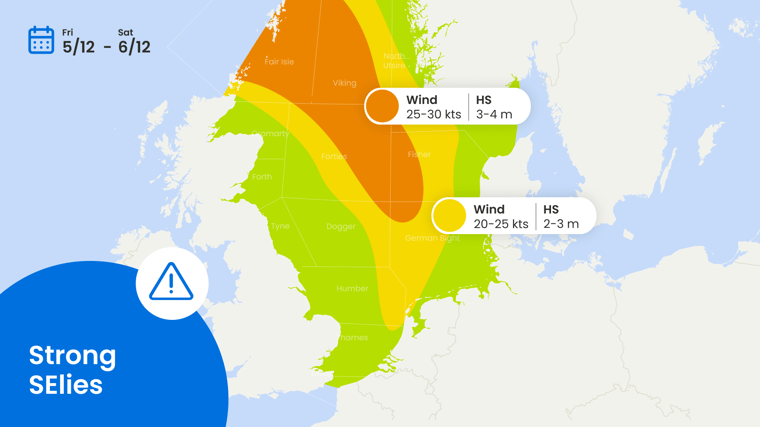
The most active front is expected on Friday and Saturday, when a new low reaches western Ireland. Ahead of it, a strong south to southeasterly wind will blow across the North Sea. In particular over the northern half of the North Sea, winds of 25-35 knots are expected, with a significant wave height (Hs) of 2-5 meters. The German Bight and areas just east of the UK will be calmer due to their sheltered position.
Very large waves in the Bay of Biscay
The most active weather over all European seas this week is expected over the Bay of Biscay. Within the complex low over the UK, a secondary low will develop and move on Thursday through the Celtic Sea toward northwestern France (Figure 2, left). South of this feature, a stormy northwesterly wind will blow, leading to very high waves in the Bay of Biscay. West of Brittany, significant wave height (Hs) will rise to 10 meters on Thursday morning. This means the theoretical maximum wave height will be around 18 meters. Later in the afternoon, the wave field will weaken slightly as it moves further into the Bay of Biscay (Figure 2, right). Even so, by the end of the day, an Hs of 5–7 meters is expected much closer to the coast as well. On Saturday, a new low is expected near Ireland leading to increase in Hs over the Celtic Sea up to 10 meters and even exceeding this value at some areas. As a result, the Sea in the Bay of Biscay is restless with waves increasing up to 5-7 meters. Although high waves occur more often in the Bay of Biscay during the winter season, an Hs of 10 meters is still exceptional. After Thursday, conditions there will become somewhat calmer again.
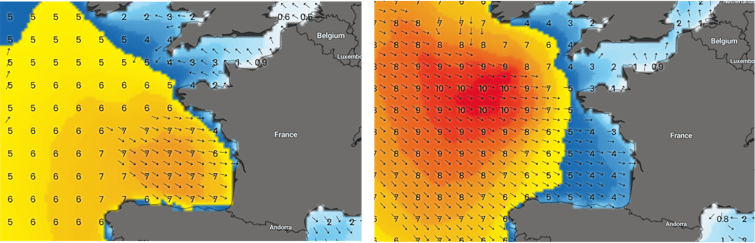 Figure 2: Hs over the Bay of Biscay on Saturday morning (left). Hs over the Bay of Biscay on Saturday afternoon (right).
Conclusion
The weather will be unsettled again over the North Sea this week, especially on Friday and Saturday. However, due to a ridge nearby there will be calmer moments as well. Especially in the coastal areas.
The most extreme weather will occur over the Bay of Biscay this week. A secondary low causes Hs to go up to 10 meters in some places. Although high Hs values are not uncommon in the Bay of Biscay, 10 meters Hs is still an exceptional weather event.
Stay updated on LinkedIn
We plan to post this Weekly Weather Update on our Infoplaza for Marine Weather Operations LinkedIn page as well. This is also the place where we will share other insightful marine weather articles, so be sure to follow us to never miss an update.