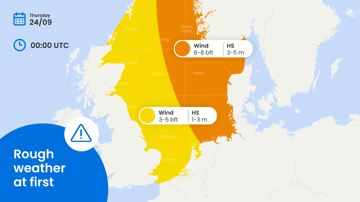

Operational conditions across the North Sea remain favorable for much of the week, with only a short-lived disruption expected on Thursday as a frontal trough crosses the basin. Conditions improve again from Friday onwards, providing a renewed window for offshore operations. Across the North Atlantic, stronger winds and higher seas continue to limit planning flexibility near Ireland, while a developing tropical system over the western Pacific warrants close monitoring.
Weather impact
- North Sea: Best workability is expected on Wednesday, with a temporary reduction on Thursday as winds increase to 20–30 knots, locally 35–40 knots in northern sectors, and wave heights build to 5.0 meters in the far north.
- North Atlantic: Waters west of Ireland experience periods of 20–30-knot winds and seas exceeding 4 meters offshore, reducing the duration of workable operational windows.
- Western Pacific: A developing tropical depression could strengthen significantly later this week, requiring close monitoring for potential impacts on routing and offshore activities.
In short: Expect only a brief interruption to North Sea operations, while conditions remain more challenging near Ireland and tropical development introduces increasing uncertainty in the western Pacific.
Operational risk
The main operational disruption is expected on Thursday across the northern North Sea, where stronger winds and higher seas may temporarily reduce offshore workability. Planning opportunities improve again from Friday, although operators in the North Atlantic and western Pacific should continue monitoring forecasts for evolving conditions.
Weather situation
North Sea
A high-pressure system north of the Azores continues to extend a ridge across the North Sea during much of the week. A low-pressure system passes north of Scotland on Wednesday before moving into the Norwegian Sea, allowing an associated frontal trough to cross the North Sea on Thursday. A secondary low develops over Scandinavia on Friday, while another weak frontal trough reaches the basin on Saturday.
Wednesday offers the most favorable conditions, with light winds and slight seas across most areas. On Thursday, winds strengthen to 20–30 knots across much of the basin, with 35–40 knots possible in northern and central-northern sectors. The southern North Sea remains comparatively sheltered. Significant wave heights increase to around 2.5 meters across much of the basin and 4.5–5.0 meters in the far north.
Conditions improve on Friday as the pressure gradient weakens. Winds ease across most sectors, although 20–30 knots may persist in northern and eastern areas, with locally stronger winds possible in the Skagerrak due to funneling. Wave heights gradually decrease to around 2.5–3.0 meters. The weekend remains largely favorable, with only brief local increases in winds and waves as another weak frontal trough passes on Saturday.
North Atlantic
A passing low-pressure system brings stronger winds and higher seas to waters west of Ireland on Wednesday. Winds increase to 20–30 knots, while significant wave heights reach around 3 meters and locally exceed 4 meters offshore.
Conditions ease temporarily on Thursday before fresh southwesterly winds of 20–30 knots return on Friday, accompanied by seas of 2.5–3.5 meters near the Irish coast. Elsewhere, an active low-pressure pattern continues to limit the duration of workable weather windows.
Western Pacific
Two tropical depressions are currently present over the western Pacific, with the eastern system showing the greatest potential to develop into a severe tropical storm or typhoon later this week.
Although uncertainty remains regarding its track and intensity, marine operators should continue monitoring forecasts closely. Further development could affect routing decisions, offshore activities and schedule resilience during the second half of the week.
Conclusion
The primary operational challenge this week is the temporary deterioration across the northern North Sea on Thursday, after which calmer conditions return. Operators in the North Atlantic should continue accounting for recurring periods of stronger winds and higher seas, while those with interests in the western Pacific should closely monitor tropical developments.
Existing customers can use the Infoplaza dashboard and forecast updates to monitor changing marine conditions and support operational planning. If you are not yet an Infoplaza customer, contact our team to discover how our weather intelligence can strengthen your operational decision-making.